
City Hall
16400 Colorado Avenue | Paramount, CA 90723
Hours
Monday through Thursday
8:00 p.m. to 5:30 p.m.
Friday
8:00 a.m. to 5:00 p.m.
Finance Department
Budget Update
About the City of Paramount’s Budget
The City of Paramount serves a mixed business and residential community of 53,000 residents and is a contract city that partners for numerous services to ensure efficient City services like public safety, law enforcement, park maintenance and trash hauling.
Fiscal Year 2026-27 Financial Overview
The General Fund serves as the primary operating fund for City services including public safety, street maintenance, environmental care and economic development. The General Fund is funded through diverse revenue streams like sales tax, assessed property tax, user fees, franchise tax and business license taxes.
In FY 2026-27, General Fund expenditures are projected to be $49.4 million while General Fund revenues are projected at $48.8 million, resulting in a $545,457 budget gap.* Rising public safety costs, inflation and other operating expenses are projected to outpace revenue growth, resulting in a cumulative deficit of $27.7 million over the 10-year forecast period, if no corrective actions are taken. The 10-year forecast below is intended to provide an early indication of these challenges and help guide future financial planning and policy decisions.
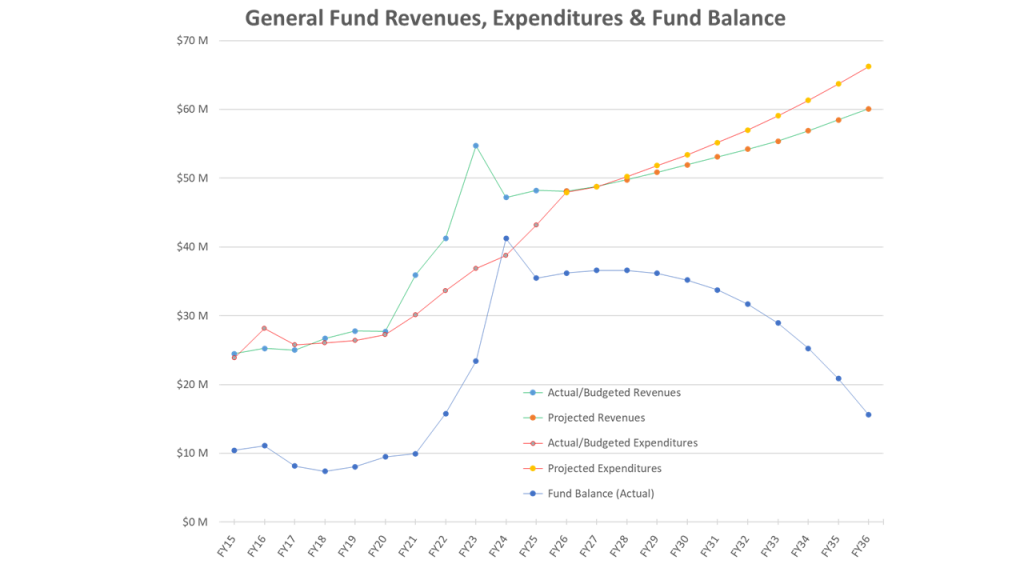
*Figures shown above and in the graph can be found in the FY 2026-27 adopted budget staff report.
Addressing Industrial and Commercial Area Investments
The City has managed the balanced evolution of the community from a commercial and industrial hub into a mixed residential and commercial/industrial environment. Commercial and industrial areas in the City provide solid jobs for our residents and create spaces for retailers to offer services to our residents. The City recognizes that small businesses and residents are part of a strong local economic strategy for the City that continues to yield benefits to the community. However, with an active industrial community comes increased wear and tear on our streets. As such, the smart financial decision is to move on to street maintenance early. Based on the City’s 2023 Pavement Management study, there is a projected cost of $43M to address all arterial/collector streets citywide serving the commercial/industrial corridor. The cost of deferring maintenance increases with each passing year. For example, a street pavement project with a cost of $6.5 million in 2026 would increase by $810k, to $7.3M if deferred to 2028.
The City currently pays $11.7 million to the Sheriff’s Department to patrol all portions of the City, including commercial and industrial. The City would like to invest $500,000 in two dedicated private security patrol cars that would be assigned to patrol only commercial and industrial businesses.
Because of the tax structure for cities in California, not all commercial and industrial businesses pay sales tax and generate tax revenues for the City. The primary source is through sales taxes on their products, but for many businesses, they either manufacture products not subject to sales tax, or the actual sale does not take place in Paramount. As a result, these entities are not paying for the total services and infrastructure they impact daily. Another common perception is that the City generates a lot of revenue from property taxes, but Paramount is a “Low Tax” City, meaning the City only gets 6.7% of property taxes paid. This is significantly lower than cities like Long Beach, where the city gets 21% of the property tax payments.
As an example of the disconnect between taxes generated and costs of services, one of the largest industrial business blocks in Paramount requires $28.7 million in street repairs due to heavy-duty wear and tear. One of the businesses in that block is a giant warehouse, which pays no sales tax and contributes $1.3 million in property tax, but the City only receives approximately $88,000 of the revenue to fund street maintenance.
To address these kinds of funding gaps so the City can continue to provide timely police service responses and road maintenance repairs, among other City services, City staff recommends that the City must proactively diversify and secure additional revenue streams.
Securing Additional Revenue Streams
City staff looked into different revenue streams that the City can strengthen to ensure there are new revenues to help offset rising expenses. The City has considered several options, such as an increased sales tax, expanding the utility user tax and adding a Cannabis tax, but all were deemed not viable.
One of the remaining options for the City is a property parcel tax that is placed only on commercial, industrial and vacant commercial/industrial properties (not residential homes and apartments). The City has modeled a potential property parcel tax based on the square footage of business property with rates that vary for vacant parcels, commercial parcels and industrial parcels. If the potential parcel tax is approved by voters, commercial properties would be charged 8¢ per square foot, industrial properties would be charged 11¢ per square foot and vacant commercial or industrial properties would be charged 13¢ per square foot.
Residential property owners and renters will not be taxed with this potential parcel tax. If the potential property tax is approved by voters, small property owners with smaller square footage will be taxed less than larger property owners.
Other cities in the surrounding area have taken similar steps to protect their infrastructure. For example, the City of Santa Fe Springs implemented a parcel tax two years ago to fund road and street improvements. That tax generates $6 million annually, with a 2% yearly increase scheduled for the next 25 years. The City of Vernon has also implemented a parcel tax on industrial, commercial and vacant land to fund City projects, health services and public safety. It also implements a warehouse-specific parcel tax. Between these two taxes, the City of Vernon is estimated to have brought in over $16 million last year.
If the potential property tax is approved by voters, the property parcel tax would generate up to $4 million in revenue that could be directly invested into roads and infrastructure, public safety, environmental care and business reinvestment.
The City plans to phase these rates over a three-year period:
- Year 1: 65% of the full rate
- Year 2: 80% of the full rate
- Year 3 and beyond: 100% of the full rate
Once the potential tax reaches 100% of the full rate in year 3, it would be subject to the built-in Consumer Price Index (CPI) cap of up to 3% to prevent runaway increases and requires an independent oversight committee to review expenditures and report annually.
To further showcase what a potential parcel tax would mean for the Paramount business community, small property owners (parcels ranging from approximately 228 to 1,178) would pay roughly $23 to $97 annually, while a large property owner would pay around $103,000 annually. Overall, 80% of the affected property owners would pay $5,000 or less per year, and 90% would pay $10,000 or less.
Fundamentally, this focused potential parcel tax is intended to ensure that costs to the City created by Paramount commercial and industrial businesses are offset by taxes paid by those businesses.
On November 3, a Special Municipal Election will be held in the City of Paramount. Paramount voters will consider the City of Paramount Public Safety, Environment, Streets and Business Improvement Measure.
Estimate Your Parcel Tax Assessment Cost
City of Paramount
Parcel Tax Estimator
Calculate your estimated annual parcel tax.
Estimated annual parcel tax
Select a parcel type and enter a lot size to see the estimate.
Step 1: To get started, visit the LA County Assessor’s Portal at portal.assessor.lacounty.gov; enter your property address to find your parcel’s land use classification (vacant, commercial or industrial) and land square footage, both of which are needed to calculate your estimate.
Step 2: Use the calculator above to estimate your annual parcel tax assessment based on your property’s land size and type.
Please note that estimates from the calculator are not final and apply only to the property owners on record. If voters approve the measure in November 2026, property owners will receive their first bill at the end of 2027 and will only be expected to pay 65% of the full rate.
Questions About Your Estimate?
If you have questions about your estimate or your property’s classification, contact the City of Paramount using the form below.
Local Business Partnerships
The City of Paramount has a reputation for proactive engagement with its business community. The City is an active participant in the Paramount Chamber of Commerce and keeps an open door to businesses of all sizes to encourage their success in Paramount. Paramount actively supports and reinvests in the commercial sector through business-friendly programs:
Financial incentives: The City has in the past provided security rebates for cameras and alarm systems, marketing grants through the Paramount Boost Program, and currently provides Chamber of Commerce scholarships to help small businesses grow.
Advisory partnerships: Paramount connects businesses with no cost advising and workforce training through the Small Business Development Center, SELACO Workforce Development Board, and the LA County Department of Economic Opportunity.
If approved, the potential parcel tax would continue to fund City programs like these, and help provide resources for new ones like grants for ADA compliance, facade improvements and trash enclosure modifications to help small businesses meet state mandates or generally aid economic development in the City.
Virtual Community Meeting
City staff recently hosted a virtual community meeting for residents to learn more about Paramount’s budget for FY 2026-27 and the current consideration of a potential parcel tax.
Residents who were unable to attend are encouraged to watch the recording linked below of the community meeting held on July 13.
Still Have Questions?
If you have any questions after watching the recording, we still want to hear from you! Please click here to submit your question and our team will get back to you.
Budget Document
Figures discussed on this page can be found in the FY 2027 adopted budget.
Frequently Asked Questions (FAQ)
The City is exploring a property parcel tax to be levied on land zones as industrial, commercial or vacant commercial/industrial property in the City of Paramount city limits. The potential taxes would be paid by the owners of the land. Residential land, such as single-family homes and apartment land, would not be subject to the parcel tax.
No. The currently proposed property parcel tax does not tax renters and residential land owners.
The formula is based on the square footage of the parcel times a certain rate per square foot. The proposed rates are 8¢ for commercial, 11¢ for industrial, and 13¢ for vacant land. If the potential parcel tax is approved by voters, it is expected that the average parcel owner will pay $3,766 per year in extra taxes, generating about $4 million per year in total new revenues for the City.
Yes. All taxes proposed by cities in California require voter approval. On November 3, a Special Municipal Election will be held in the City of Paramount. Paramount voters will consider the City of Paramount Public Safety, Environment, Streets and Business Improvement Measure. As a parcel tax, the measure will require 2/3rds (66.6% +1) voter support for the measure to be adopted. If voters adopt the measure, it will take effect in 2027 and will have a three-year phase-in period for the taxes to take full effect.
The City is looking to invest the tax revenues into roads and infrastructure, public safety, business reinvestment, and environmental services. The commercial and industrial areas of Paramount need significant road repairs, and increased business burglary activity has been a rising concern for businesses and the community in general. Taxes raised from this measure will help fund City service areas as a general fund tax.
The City of Paramount offers financial incentives to local businesses through the Paramount Boost Program and Chamber of Commerce scholarships to help businesses grow. The City also connects businesses with free advising and workforce training through their partnership with Small Business Development Center, SELACO Workforce Development Board and the LA County Department of Economic Opportunity. Finally, the City has focused on providing timely review of business licenses, land application and other administrative processes to both ensure businesses are meeting safety and health standards while also helping businesses move fast and invest in the community.
The City of Paramount has low property tax compared to neighboring cities. This means the city only gets a small share of property taxes for all property taxes paid. In Paramount, that is 6.7% of taxes paid. So if a property owner writes a $10,000 annual check to the LA County Assessor for property taxes, the City gets $670 of that tax revenue. The rest of the revenue goes to the County of Los Angeles, State of California and Paramount Unified School District, the County Library and Special Districts.
The City of Paramount is home to 1,062 business-owned taxable parcels, made up of 379 commercial properties, 579 industrial properties, and 104 vacant commercial/industrial parcels, making the City one of the top locations for commercial and industrial businesses in Los Angeles County.
A general property tax is a value-based tax (ad valorem) set as a percentage of the assessed value for all properties owned in Paramount, both residential and commercial. A property parcel tax is a special, non-value-based tax determined by the parcel size owned by business owners. The City is considering a parcel tax, not a property tax.
The City of Santa Fe Springs has implemented a parcel tax to fund road and street improvements. That tax generates $6 million annually, with a 2% yearly increase scheduled for the next 25 years.
The City of Vernon has also implemented a parcel tax on industrial, commercial and vacant land to fund City projects, health services and public safety. It also implements a warehouse-specific parcel tax. Between these two taxes, the City is estimated to have brought in $16,245,000 for FY 24/25.
The $2 million generated annually from the parcel tax would be used to pay back a bond, similar to a loan, that would allow the City to complete $30 million in road repairs in commercial and industrial areas over five years.
After the $30M in road repairs are completed in the first five years, the City will continue using other dedicated road funding it receives, like gas tax and county transportation funds, to cover broader citywide road maintenance. The revenue generated from the potential parcel tax would prioritize and accelerate the repair of streets that have the biggest impact from heavy trucks and industrial activity. If the City were to wait and defer these projects, a road project that costs $6.5 million today will cost $7.3 million by 2028.
Parcel tax bills are sent through the LA County Assessor, the same way regular property taxes are collected. If voters approve the measure in November 2026, the tax would gradually phase in at 65% in Year 1, 80% in Year 2, and 100% in Year 3, to give property owners time to adjust.
Property owners would receive their first bill in 2027 and only be expected to pay 65% of the full rate. Payments are split into two installments:
- First payment (half of what's owed for Year 1): due by December 2027
- Second payment: due by April 2028
If the City does not secure an additional stream of revenue soon, the financial forecast for the next ten years projects a $27.7 million budget shortfall.
City staff and the City Council have already explored a utility user tax increase, a cannabis tax, a general obligation bond, a sales tax increase and other alternatives, and ruled each one out as not viable. The City has also made internal cuts: reducing the citywide operating budget by 5%, freezing vacant staff positions, cutting part-time hours, limiting overtime and deferring equipment purchases.
City staff and the City Manager believe that a targeted parcel tax on commercial and industrial properties is the most viable option, generating a projected $4 million in annual revenue that would go straight into the General Fund, which supports services like public safety, road repair, environmental care and economic development.
The proposed rates are 8¢ per square foot for commercial properties, 11¢ per square foot for industrial properties and 13¢ per square foot for vacant commercial or industrial land.
80% of affected property owners would pay $5,000 or less per year and 90% would pay $10,000 or less per year. For example, a small business owner with a property between 228 and 1,178 square feet would pay between $23 and $97 per year, and a large property owner would pay around $103,000 per year.
Below is a breakdown of the estimated parcel tax across Paramount's 1,062 affected parcels at full implementation:
Annual Tax Amount | Share of Parcels | Approx. # of Parcels |
Less than $1,000 | 38.4% | ~408 |
$1,001 – $5,000 | 41.6% | ~442 |
$5,001 – $10,000 | 10.1% | ~107 |
$10,001 – $20,000 | 7% | ~74 |
$20,001 – $40,000 | 2% | ~21 |
$40,001 – $70,000 | 0.6% | ~6 |
$70,001 – $100,000 | 0.2% | ~2 |
$100,001 – $125,000 | 0.1% | ~2 |
Residential property owners and renters would not be subject to this tax, as it would only apply to commercial, industrial and vacant commercial or industrial properties.
To find out what your specific property would owe, visit the LA County Assessor's Portal at portal.assessor.lacounty.gov to look up your property's land use classification and square footage, then use the calculator mentioned on this webpage.
If the proposed parcel tax is not approved by voters, the City may continue to experience potential budget shortfall projections. In the event of a future shortfall, the city may consider other revenue measures, reserve spending, or a reduction of services and programs based on City Council direction.